SAP's New Data Strategy: Why Dremio and the 2026 API Policy Change Everything

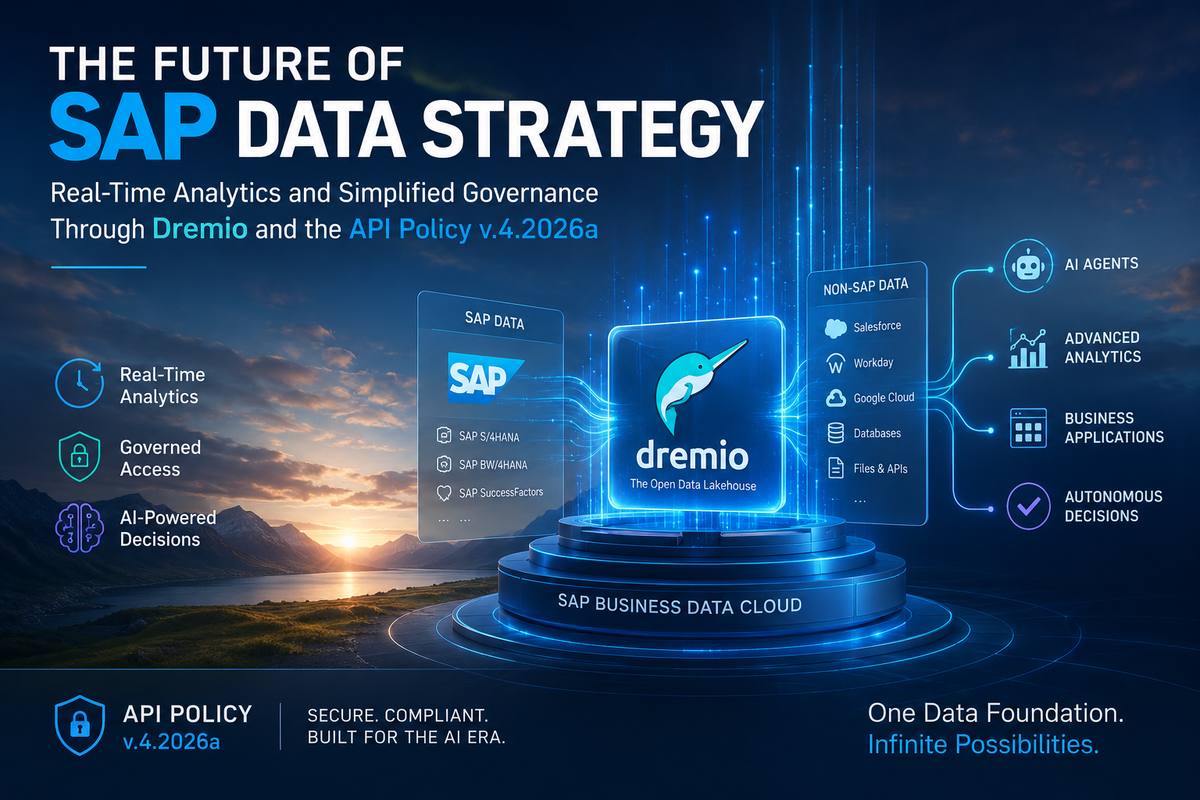
Executive Summary & Key Takeaways
- The Era of ETL is Ending: SAP's July 2026 acquisition of Dremio embeds an open data lakehouse directly into the Business Data Cloud, enabling zero-data-movement analytics.
- Strict New Guardrails: The SAP API Policy v.4.2026a and recent security patches (like the June 2026 ODP-RFC block) strictly prohibit unsupervised point-to-point data scraping by third-party AI agents to protect the S/4HANA core.
- The AI Mandate: To safely power "Agentic AI," enterprises must adopt decoupled architectures using SAP-endorsed standards like the Model Context Protocol (MCP) and Agent2Agent (A2A).
- Action Required: SAP Basis teams and Enterprise Architects must immediately audit existing extraction pipelines, transition off undocumented APIs, and rethink contract negotiations ahead of 2027 pricing cliffs.
Introduction
SAP is fundamentally changing how customers access enterprise data.
Within just a few months, the company introduced two strategic initiatives that will shape SAP architectures for years to come:
- The enforcement of the new SAP API Policy v4.2026a, restricting unsupported data extraction methods.
- The acquisition of Dremio, bringing an open data lakehouse directly into SAP Business Data Cloud.
At first glance, these announcements appear unrelated. In reality, they are two sides of the same strategy.
SAP is moving away from traditional point-to-point integrations and bulk data extraction toward a governed, real-time data platform designed for analytics, AI, and autonomous business processes.
For SAP architects, Basis administrators, integration specialists, and CIOs, this is more than a licensing or compliance update. It represents a fundamental architectural shift that will influence how enterprise data is accessed, governed, and consumed over the next decade.
In this article, we'll examine:
- Why SAP introduced the new API restrictions.
- How Dremio fits into SAP Business Data Cloud.
- What the June 2026 ODP-RFC security changes really mean.
- How MCP and Agent2Agent fit into SAP's AI strategy.
- What organizations should do today to prepare.
The API Policy v.4.2026a: Protecting the Digital Core
Historically, feeding enterprise data lakes or training AI models meant relying on "wild" data scraping or continuous bulk polling.
In the era of Agentic AI—where autonomous agents might execute thousands of rapid-fire API calls to reconcile a supply chain issue—this old approach is a recipe for disaster. A core ERP system tuned for predictable, human-paced transactional workloads will easily crash under the weight of unsupervised agentic swarms.
Enter Section 2.2.2 of the new SAP API Policy. This clause explicitly prohibits the use of SAP APIs for interaction with autonomous AI systems that plan and execute unmanaged sequences of API calls.
This isn't just a policy document; it is backed by hard technical enforcement.
Practical Example for SAP Basis Administrators: On June 9, 2026, SAP shipped security patch SAP Note 3255746, technically blocking non-compliant ODP (Operational Data Provisioning) data extraction via RFC. If your third-party data integration tools were relying on ODP-RFC for massive extractions into external data warehouses, those pipelines are now functionally broken. You must audit your systems using SAP Note 3439624 and transition to endorsed alternatives like ODP-OData or Delta Sharing.
Enter Dremio: The Open Data Lakehouse Solution
If SAP is closing the door on direct, chaotic data extraction, how are you supposed to feed your AI?
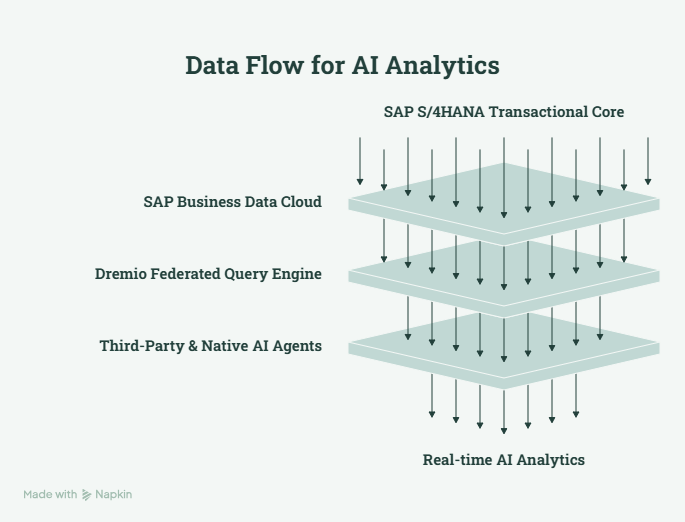
This is exactly why SAP acquired Dremio in July 2026. Dremio acts as the legally endorsed, high-performance pathway to your data. By integrating Dremio directly into the SAP Business Data Cloud (BDC), SAP provides a federated query engine that reads data precisely where it resides.
Instead of extracting, transforming, and loading (ETL) terabytes of data across the network, Dremio leaves the data in low-cost object storage and scales compute dynamically. This "zero-data-movement" approach slashes storage costs, eliminates latency, and keeps the S/4HANA transactional core perfectly isolated from heavy analytical workloads.
The Decoupled Architecture
Here is how the modern SAP data flow looks today:
Technical Deep Dive: The Open-Source Engine
Dremio's speed and flexibility aren't locked behind a proprietary black box. It relies on three critical open-source standards:Apache Iceberg: The definitive open table format that brings SQL-like ACID transactions to raw data lakes.Apache Polaris: A universal catalog standard (co-created with Snowflake) that provides centralized discovery and role-based access control. In SAP, this powers the underlying Knowledge Graph.Apache Arrow: An in-memory columnar format that eliminates serialization overhead, allowing Dremio to deliver sub-second federation across massive datasets.
Furthermore, SAP's recent acquisitions of Reltio (for real-time Master Data Management) and Prior Labs (Tabular Foundation Models for relational ERP data) ensure the data fed through Dremio is clean, unified, and natively understandable by AI.
How AI Actually Talks to SAP: MCP and A2A
Because Section 2.2.2 forbids direct third-party AI scraping, SAP has heavily invested in two open standards to safely bridge the gap between AI and the ERP core.
1. The SAP Integration Suite MCP Gateway The Model Context Protocol (MCP) standardizes how AI agents connect to enterprise tools. Instead of exposing raw database CRUD operations (which are highly vulnerable), the new SAP MCP Gateway enforces "intent-shaped" tools. Rather than an AI agent making five separate API calls to approve a purchase, it calls one MCP macro-tool (approve_purchase_requisition). The server handles the complex business logic, vastly reducing token consumption and protecting S/4HANA from runaway loops.
2. Agent2Agent (A2A) Coordination What if you are using Salesforce Agentforce or a custom Microsoft Copilot instance? You use A2A—the new HTTP of the AI world. Instead of your external AI querying SAP directly, it uses A2A to delegate the task securely to an internal SAP Joule Agent. Joule executes the task within the secure SAP perimeter and hands the finished result back to your external Copilot.
What Should Enterprise Architects and CIOs Do Today?
A passive approach to SAP’s 2026 roadmap is no longer viable. Here are the immediate steps organizations must take to align with this new reality:
1. Audit API Dependencies Immediately Cross-reference all custom applications, middleware, and third-party tools against the SAP Business Accelerator Hub. Any integration relying on non-published, undocumented APIs will break. Transition massive extraction workloads away from legacy ODP-RFC to modern Delta Sharing.
2. Shift to a Decoupled System of Intelligence Stop building point-to-point integrations for analytics. Adopt the SAP Business Data Cloud and utilize Dremio to federate queries across your SAP and non-SAP data. This isolates your System of Record from your System of Intelligence.
3. Prepare for 2027 Contract Renewals SAP is mirroring the "Microsoft Teams" playbook: offering Joule for Developers and Joule Studio for free through the end of 2026 to drive massive entrenchment. IT procurement teams must negotiate explicit post-promotion price ceilings now to prevent massive budget shocks in 2027 when the free tiers expire.
Conclusion
SAP's dual maneuver—the stringent API Policy v.4.2026a and the Dremio acquisition—initially looked like aggressive vendor gatekeeping. In reality, it is a necessary forcing function. By closing the door on fragile, legacy data scraping, SAP is pushing enterprise architects toward the highly performant, federated, and decoupled architectures required to survive the Agentic AI era. Organizations that embrace this governed data fabric will dramatically lower their ETL costs while safely scaling their AI initiatives.