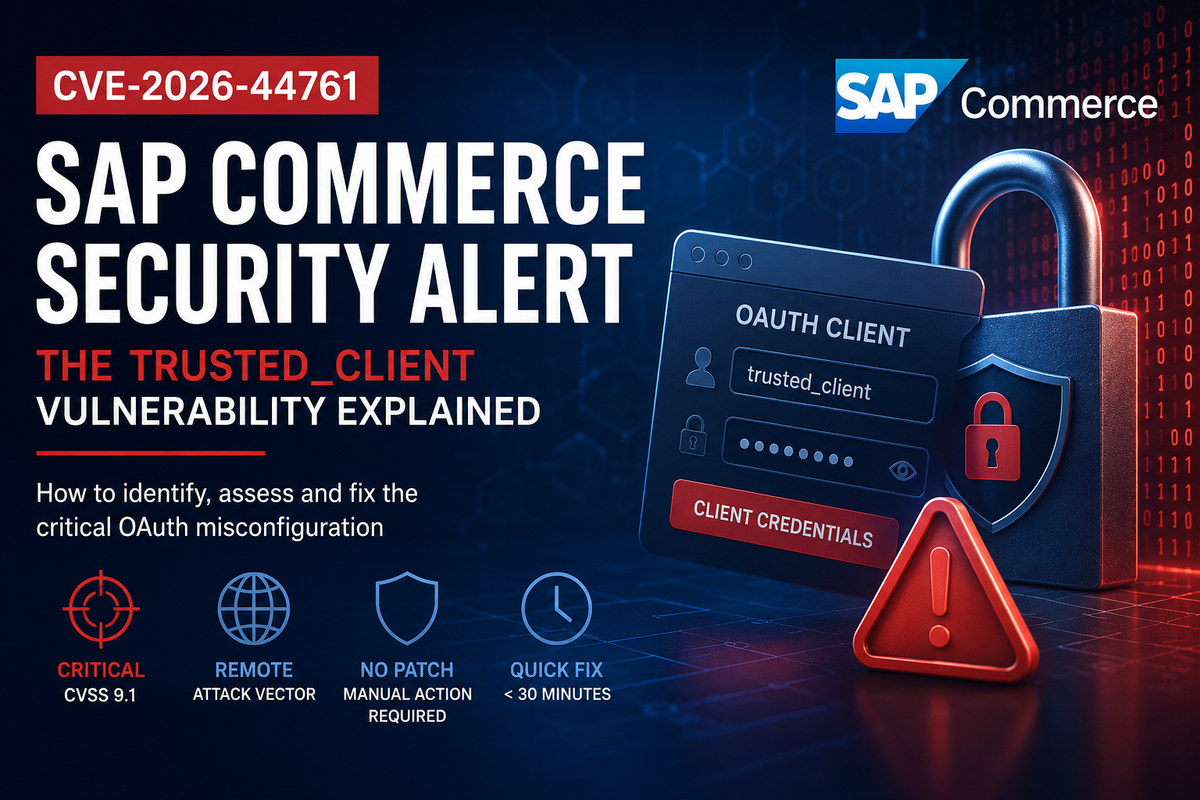
CVE-2026-44761 Explained: How to Find and Remove the Dangerous trusted_client OAuth Client in SAP Commerce
CVE-2026-44761 is a critical SAP Commerce vulnerability (CVSS 9.1) caused by publicly documented OAuth sample credentials. Learn how to identify vulnerable trusted_client configurations, verify your system, and remediate the issue without downtime.

Every month SAP releases dozens of security fixes. Most address software defects that can be resolved by applying SAP Notes or updating system components.
CVE-2026-44761 is different.
Released as part of the July 2026 SAP Security Patch Day, this vulnerability has a CVSS score of 9.1 (Critical), yet it isn't caused by a programming bug.
Instead, it stems from sample OAuth credentials that were published in SAP documentation and may have been imported into production systems during implementation.
This makes the vulnerability particularly dangerous:
- there is no software patch that automatically fixes it;
- many vulnerable systems may believe they are fully up to date;
- remediation requires a manual security review by SAP Commerce administrators.
If your organization runs SAP Commerce (Hybris), this should be one of the first items on your security checklist.
At a Glance
| Category | Value |
|---|---|
| CVE | CVE-2026-44761 |
| Severity | 🔴 Critical |
| CVSS v3.1 | 9.1 |
| Affected Product | SAP Commerce Cloud / SAP Commerce |
| Root Cause | Public sample OAuth client credentials |
| Patch Available | ❌ No |
| Manual Action Required | ✅ Yes |
| Downtime Required | None |
Why This Vulnerability Exists
During SAP Commerce implementations, developers frequently use SAP's sample ImpEx scripts to configure the Omni-Channel Connect (OCC) REST APIs.
Historically, SAP documentation included an example OAuth client named:
trusted_client
along with a publicly documented client secret.
If that sample configuration was imported into a productive system without changing or removing the credentials, an attacker who knows the published secret can authenticate against the OAuth service and obtain an access token.
In other words:
Public documentation accidentally became a production credential.
Unlike a coding vulnerability, the software behaves exactly as designed—the insecure configuration is the problem.
Business Risk
From a business perspective, this vulnerability deserves immediate attention.
| Metric | Assessment |
|---|---|
| Attack Vector | 🌍 Remote (Network) |
| Authentication Required | None |
| Attack Complexity | Low |
| Confidentiality Impact | High |
| Integrity Impact | High |
| Availability Impact | None |
| Business Risk | Critical |
An attacker could potentially:
- retrieve customer information;
- access product catalog data;
- manipulate orders;
- modify business information through exposed REST APIs;
- perform administrative API operations.
The system will usually continue operating normally, making this type of compromise difficult to detect.
Is Your System Actually Vulnerable?
Fortunately, not every SAP Commerce installation is affected.
A system is vulnerable only if all three conditions are true.
1. The sample OAuth client exists
Search for:
trusted_client
If the client does not exist, you're not vulnerable.
2. The default secret is still configured
If the client secret was replaced with a unique password, the published credentials no longer work.
3. The OAuth endpoint is accessible
The authorization endpoint can be reached by an attacker.
Even internally accessible systems should still remove the sample client as part of good security hygiene.
Step 1 – Check the OAuth Clients
Open SAP Commerce Backoffice and navigate to:
System
   → OAuth
      → OAuth Clients
Search for:
trusted_client
Possible outcomes:
✅ Not found
Your system is not affected.
⚠️ Found but disabled
The immediate risk is significantly reduced, but removing unused clients is still recommended.
🚨 Found and enabled
Continue with verification.
Step 2 – Test the Credentials
SAP administrators can verify whether the published credentials are still valid by requesting an OAuth token.
Example:
curl -X POST \
https://<hostname>/authorizationserver/oauth/token \
-u "trusted_client:<sample_secret>" \
-H "Content-Type: application/x-www-form-urlencoded" \
-d "grant_type=client_credentials"
Results:
HTTP 200
🚨 Vulnerable
The default secret is still active.
HTTP 401 Unauthorized
✅ The credentials were changed.
The sample password no longer works.
Step 3 – Remove the Client
In most environments, the safest solution is simply to remove the sample client.
From Backoffice:
- Open OAuth Clients
- Select trusted_client
- Delete it
- Verify it no longer exists
No restart is required.
No downtime is required.
What if an Integration Uses It?
Although uncommon, some custom developments may have reused the sample client.
If deleting it would impact an application:
- immediately rotate the client secret;
- generate a strong random value;
- update every dependent integration;
- verify OAuth authentication afterwards.
Never continue using publicly documented credentials.
Don't Forget About mobile_android
While reviewing OAuth clients, you may also notice:
mobile_android
Fortunately, this client is not affected by CVE-2026-44761.
By default it only has permissions for anonymous resources.
However, if you're running SAP Commerce 2211 on JDK 21 and no longer rely on legacy mobile functionality, SAP recommends removing it to reduce the attack surface.
Why This Vulnerability Matters
One of the most interesting aspects of CVE-2026-44761 is that it highlights a common misconception:
Being fully patched does not necessarily mean being secure.
Traditional vulnerability management focuses on software defects.
This issue demonstrates that configuration reviews are equally important, especially when sample code or implementation guides are involved.
Security teams should periodically audit:
- default accounts;
- sample users;
- OAuth clients;
- API keys;
- developer credentials;
- test certificates;
- legacy integrations.
Removing unused objects is often one of the quickest ways to improve an organization's security posture.
Key Takeaways
- 🔴 CVE-2026-44761 is a Critical (CVSS 9.1) vulnerability affecting SAP Commerce.
- ⚠️ The issue is caused by sample OAuth credentials, not a software defect.
- 🔍 There is no automatic SAP patch that resolves the problem.
- ✅ Check whether the
trusted_clientOAuth client exists. - 🔑 Verify the default secret is no longer valid.
- 🗑️ Delete the client if it isn't required.
- 🚫 No downtime or application restart is necessary.
- 🛡️ Treat this as an opportunity to audit all legacy OAuth clients and sample credentials across your SAP Commerce landscape.
Final Thoughts
CVE-2026-44761 serves as an important reminder that security isn't just about applying patches—it's also about eliminating insecure configurations left behind during implementation. A five-minute review of your OAuth clients could prevent unauthorized access to critical business data.
For SAP BASIS, SAP Commerce, and Security teams, this is one of those rare vulnerabilities where a simple administrative cleanup delivers a significant reduction in risk.