CVE-2026-27690: Critical HTTP Request Smuggling Vulnerability in SAP Approuter
CVE-2026-27690 is a critical HTTP Request Smuggling vulnerability affecting SAP Approuter in non-Cloud Foundry environments. This article explains the risk, affected systems, and how to deploy the required fixes.

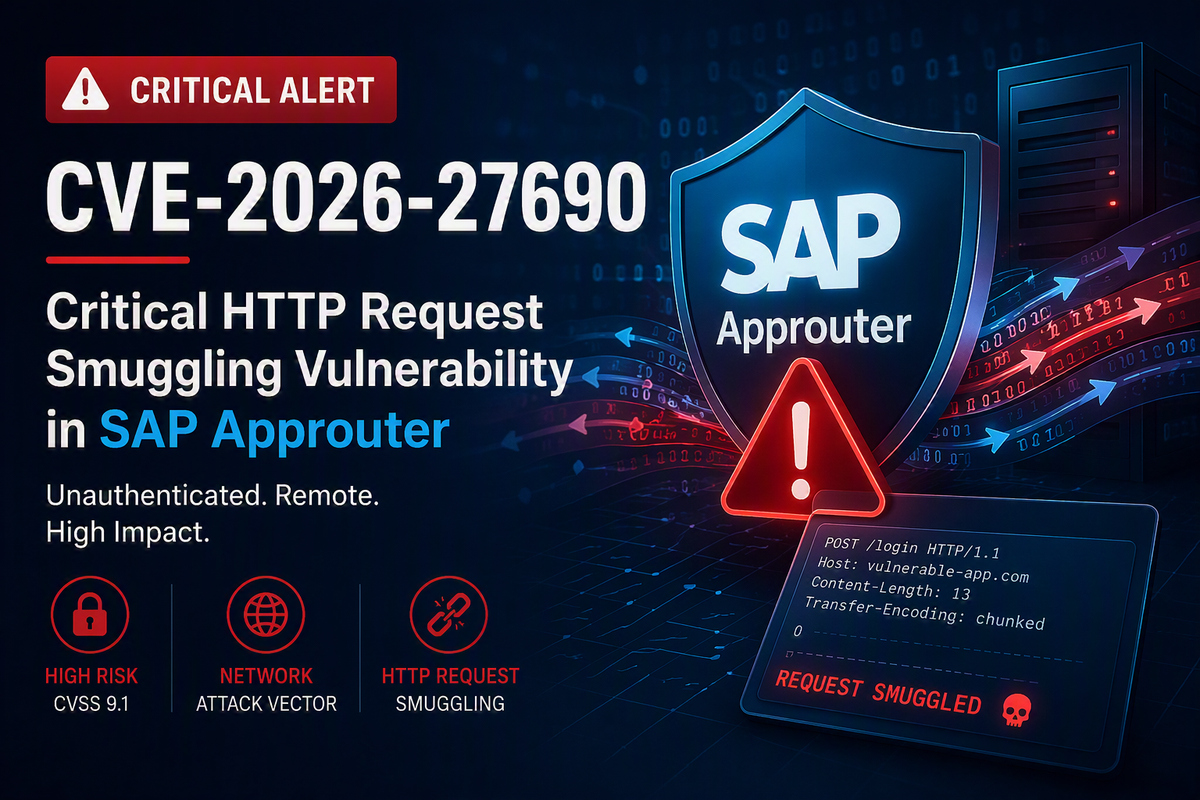
A newly disclosed critical vulnerability affecting SAP Approuter could allow unauthenticated attackers to disrupt services and potentially access sensitive user data. Tracked as CVE-2026-27690 and assigned a CVSS score of 9.1, this issue requires immediate attention from organizations running SAP Approuter outside of Cloud Foundry environments.
In this article, we'll explain what the vulnerability is, who is affected, and the actions SAP administrators should take to mitigate the risk.
What Is CVE-2026-27690?
CVE-2026-27690 is an HTTP Request Smuggling vulnerability in SAP Approuter. The flaw stems from improper handling of HTTP requests, allowing an attacker to create a request-response desynchronization between front-end and back-end systems.
Because the vulnerability can be exploited remotely without authentication or user interaction, it represents a significant risk for exposed environments.
An attacker could send specially crafted HTTP requests that manipulate how requests are interpreted by different components in the application chain, potentially leading to:
- Exposure of responses intended for other users
- Service disruptions and application unavailability
- Unpredictable behavior in routing and session handling
The vulnerability primarily impacts SAP Approuter deployments running in non-Cloud Foundry (non-CF) environments.
CVSS Breakdown
| Metric | Value |
|---|---|
| CVSS Version | 3.0 |
| Base Score | 9.1 (Critical) |
| Attack Vector | Network |
| Attack Complexity | Low |
| Privileges Required | None |
| User Interaction | None |
| Confidentiality Impact | High |
| Integrity Impact | None |
| Availability Impact | High |
The combination of network-based exploitation, no authentication requirements, and high confidentiality and availability impacts places this vulnerability in SAP's highest-priority remediation category.
Who Is Affected?
Organizations running SAP Approuter outside of Cloud Foundry should immediately assess their environment.
SAP HANA XS Advanced (XSA) Environments
For customers using SAP HANA Extended Application Services, Advanced Model (XSA), determining exposure requires understanding where SAP Approuter is deployed.
Not Affected
The following XS Advanced Core Delivery components do not contain SAP Approuter and are therefore not vulnerable:
- XS Controller (
xscontroller) - XS Execution Agent (
xsexecagent) - XS UAA Server (
xsuaaserver) - Audit Log Service
- Deploy Service
- Product Installer
Potentially Affected
The vulnerable Approuter dependency may exist in:
- XS Advanced Installation Media
- SAP-delivered business applications
- Custom-developed XSA applications
- Third-party applications
- SAP HANA Cockpit 2.0
- SAP Omnichannel Promotion Pricing
- Other applications embedding SAP Approuter
Because Approuter is commonly bundled within application packages, administrators should inventory all deployed applications to identify potentially vulnerable versions.
Technical Cause and Mitigation
SAP's fix addresses the way connections are reused in non-Cloud Foundry deployments.
The remediation automatically enables the following configuration:
DISABLE_CONNECTION_REUSE=true
Disabling connection reuse prevents the request desynchronization scenario that enables HTTP Request Smuggling attacks.
Remediation for Node.js Deployments
If you directly manage SAP Approuter as a Node.js dependency, upgrade immediately to:
@sap/approuter 20.10.0 or later
After upgrading, rebuild and redeploy all affected applications.
Remediation for SAP HANA XS Advanced (XSA)
XS Advanced Installation Media
Customers using XS Advanced Installation Media should upgrade to:
XS Advanced Revision 32 or later``
This revision includes the corrected SAP Approuter dependency.
SAP-Delivered Business Applications
Install the latest patches available for SAP-provided applications that bundle Approuter.
SAP notes that this requires at least:
XS Advanced 1.4.0
to support deployment of the corrected components.
Custom Applications
For custom-developed applications:
- Update the application's
package.json. - Reference
@sap/approuterversion 20.10.0 or later. - Redeploy the application.
Typical XSA deployment commands include:
xs restage <application-name>xs restart <application-name>
These commands ensure the updated dependency is loaded into the running environment.
Third-Party Applications
If the vulnerable Approuter component is packaged by an external vendor, obtain an updated version directly from the software provider and follow their upgrade instructions.
Product-Specific Fixes
Several SAP solutions require dedicated fixes in addition to general Approuter remediation.
SAP HANA Cockpit 2.0
Install:
SAP HANA Cockpit 2.0 SPS18 Revision 7Version 2.18.7
using the package available through the SAP Software Download Center.
SAP Omnichannel Promotion Pricing
Apply the release-specific corrective notes provided by SAP, including:
- SAP Note 3745608 (Release 2.9.1)
- SAP Note 3752743 (Release 2.8.2)
SAP HANA DW Foundation (DWF)
Follow the guidance outlined in:
SAP Note 2435452
to determine and implement the appropriate mitigation path.
Recommended Actions for Security Teams
Given the critical severity of CVE-2026-27690, organizations should:
- Identify all SAP Approuter deployments running outside Cloud Foundry.
- Inventory SAP and custom applications containing the
@sap/approuterdependency. - Upgrade to
@sap/approuter 20.10.0or later wherever applicable. - Apply all relevant SAP Security Notes and product-specific patches.
- Verify application functionality after deployment.
- Prioritize internet-facing systems for immediate remediation.
Final Thoughts
HTTP Request Smuggling vulnerabilities remain one of the more dangerous classes of web application flaws because they can bypass traditional security controls and create unexpected interactions between infrastructure components. With a CVSS score of 9.1, CVE-2026-27690 should be treated as a high-priority remediation item for any organization running SAP Approuter in non-Cloud Foundry environments.
If your landscape includes SAP HANA XSA, SAP HANA Cockpit, custom Node.js applications, or third-party software that embeds SAP Approuter, review your deployments immediately and apply the latest patches to reduce exposure.